Get free quotes from chimney inspection near you
Takes about a minute. Free, no obligation; providers reply to you directly.
I showed up to my first chimney inspection with a $300 camera kit I’d bought online, all shiny and new, ready to revolutionize my business. The salesman had promised crystal-clear imaging, game-changing efficiency, the whole pitch. Three jobs in, the cable got tangled in a flue bend. The monitor froze. I spent forty minutes troubleshooting while my client watched from the living room, increasingly skeptical that I knew what I was doing.
That’s when I realized the truth: the camera didn’t matter nearly as much as I’d been told. What mattered was knowing how to use it—and more importantly, knowing whether I even needed it in the first place.
The Short Version
Buy an inspection camera ($100–$150 for electric models) only if you’re already solid on technique and client communication. High-end systems like the Wöhler VIS 400 aren’t marketing hype, but they’re not magic either—and most of what you read about “revolutionizing” inspections is true, just incomplete. Better gear doesn’t fix bad technique. Better technique makes reasonable gear worth its weight.
Key Takeaways
- Inspection cameras are legitimately useful for Level II inspections and building client trust—but only if your fundamentals are locked in
- The $100–$150 electric models deliver 80% of the value at 20% of premium costs; Wöhler systems justify their price through durability, not just specs
- The real money move: pair cameras with HEPA vacuums and brushes; cameras alone create mess and frustration
- Most marketing conflates “non-invasive” with “effective”—they’re not the same thing
What the Industry Wants You to Believe (and What’s Actually True)
Marketing copy around chimney inspection cameras leans hard on one claim: they’re revolutionizing the industry by making inspections non-invasive and reducing dismantling needs by up to 100% in many cases. That’s not wrong, exactly. It’s just incomplete in a way that costs money.
The honest version: cameras are useful if you already have solid fundamentals. If your brush work is sloppy, your vacuum strategy is weak, or your client communication isn’t clear, a $500 Wöhler won’t fix that. You’ll just have high-definition video of a mediocre inspection.
Here’s what actually matters: cameras reduce labor time and build trust. That’s it. They don’t diagnose creosote buildup faster than experience does. They don’t replace the tactile feedback of running a brush through a flue. What they do is let you show clients exactly what you found, navigate tight spots without roof access, and catch blockages that a visual-only inspection might miss.
The gear companies don’t say this part because it doesn’t sell cameras.
The Real Hierarchy: What Belongs in Your Kit
Every source on this topic—CSIA instructors, ServiceTitan guides, Housecall Pro documentation—lists roughly 16–17 essential tools. But they’re not all equal.
Top tier (non-negotiable):
- Wire or polypropylene brushes
- Flexible rods
- HEPA vacuum system
- Respirator and PPE
- LED inspection light
Second tier (highly useful, not optional):
- Inspection camera ($100–$150)
- Drop cloths
- Inspection mirrors
Third tier (nice-to-have, context-dependent):
- Power sweeping systems
- Multiple brush sizes for specialty work
The reason this matters: you can do a competent Level I inspection with just the top tier. You can do a Level II inspection legally without a camera (though it’s harder). But you cannot do either safely without the vacuum, brushes, and respiratory protection. Nobody tells you this because it’s boring.
Cameras get the marketing budget because they’re visible, impressive-looking, and easier to sell. But the vacuum—the unglamorous $200–$400 piece of equipment that captures the debris cloud—is what separates a professional from someone doing surface-level work.
The Equipment Reality Check: Budget vs. Premium
| Tool | Budget Option | Premium Option | Actual Difference |
|---|---|---|---|
| Inspection Camera | $100–$150 electric with flexible cable, smartphone connection | Wöhler VIS 400 modular kit (exact price varies; positioned as high-end investment) | Wöhler waterproof head, larger screen, modular rods. Better durability and ergonomics. Not worth upgrading if you’re part-time. |
| LED Light | $50 basic rechargeable | $130 robust, hands-free, high lumen output | Budget models work fine for basic inspections; premium justifies cost only if you’re doing 200+ jobs/year. |
| Brush Set | $40–$80 basic wire/poly brushes | $150+ specialty sets with multiple diameters and materials | Budget set handles 95% of work. Premium sets are for unusual flue shapes. |
| HEPA Vacuum | $300–$500 portable shop vac with HEPA filter | $800+ dedicated chimney vacuum system | This is where budget hurts. Cheap vacuums leak fine soot particles, create respiratory risk, and need frequent filter replacement. Not the place to pinch pennies. |
Here’s what the data actually says: a camera in the $100–$150 range connects to your smartphone, shares photos with clients in real-time, and gives you high-res stills. That’s 85% of what most inspectors need. The Wöhler systems excel at durability, intuitive interface, and waterproof components—legitimate advantages if you’re doing high-volume work or working in wet conditions. But they don’t make you better at finding creosote buildup. You do.
Reality Check:A $150 camera with weak technique is worse than no camera at all. You’ll spend twice as long navigating the flue, miss what you’re looking for, and come away with footage that doesn’t help your client understand the problem. Before you buy, practice with borrowed equipment and nail your inspection flow.
The Vacuum Question (Everyone Gets This Wrong)
This is the hill I’ll die on: if you’re going to upgrade one tool, upgrade your vacuum, not your camera.
A HEPA vacuum system prevents soot fallout into the home, protects your respiratory health, reduces cleanup time by 60%, and actually builds client confidence more than any camera footage. But here’s what happens: pros see a shiny $500 camera and think “that’s my upgrade,” while their $80 shop vac with a standard filter is leaking fine particles that they’re breathing in.
The combo that works: a decent HEPA vacuum + a $100 camera + solid technique beats a fancy camera + weak equipment strategy every single time.
ServiceTitan and BellaFSM both emphasize this implicitly—they mention cameras in a framework of complete inspection systems, not as standalone tools. The camera is the final piece that documents what your vacuum, brushes, and technique have already accomplished.
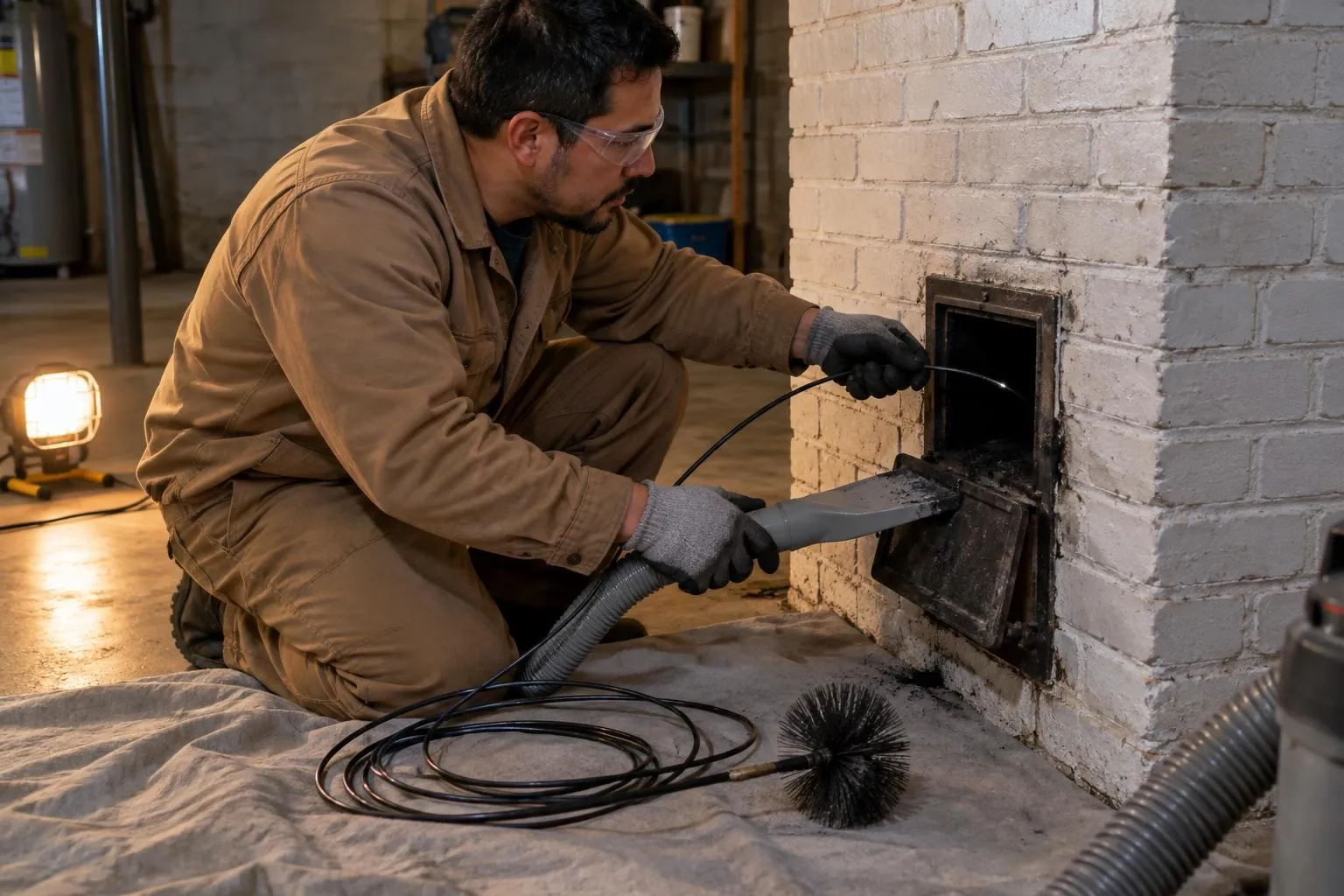
Pro Tip:Pair your camera with a HEPA vacuum that captures debris before it hits the air. Film the cleaned flue after you’ve brushed and vacuumed, not before. This gives clients visual proof that you actually solved the problem, not just documented it.
Cameras for Client Trust (The Honest Angle)
Here’s the one area where marketing and reality align: showing clients what you found builds credibility.
A homeowner sees creosote buildup, a blockage, or a crack on their smartphone screen—that’s more convincing than hearing you describe it. It’s not that they don’t trust you; it’s that they can’t visualize it. The camera closes that gap.
This is where the $100–$150 models shine. They’re affordable enough that ROI comes from efficiency (fewer callbacks, faster inspections, fewer follow-up explanations) rather than from premium durability. Budget cameras are plenty robust for this job.
The Wöhler VIS 400 makes sense if you’re doing 300+ inspections yearly and need bulletproof reliability. For everyone else, it’s over-equipped.
Reality Check:A camera doesn’t replace good communication. You still need to explain what creosote buildup means for fire risk, why a crack matters, and what the next step is. The footage is the supporting evidence, not the diagnosis.
The Practical Bottom Line
Step 1: Nail your fundamentals first. Master brush techniques, build a solid vacuum workflow, and develop a clear client communication script. A camera won’t fix these.
Step 2: Buy a budget electric camera ($100–$150) once you’re doing steady work. Teslong and similar brands deliver high-res imaging at entry-level prices. Pair it with a smartphone mount so you can share footage immediately.
Step 3: Invest in a real HEPA vacuum system ($300–$500) before you even think about premium cameras. This is where safety and efficiency actually live.
Step 4: Only upgrade to high-end gear (Wöhler VIS 400 or similar) if you’re doing 250+ jobs annually and can justify durability advantages through volume.
The truth nobody in the gear industry wants you to know: expensive equipment is rarely the bottleneck. Poor technique, weak communication, and skipped steps are. Fix those first, then let reasonable gear amplify what you’re already doing well.
Related: Learn more about the core inspection process in our Complete Guide to Chimney Inspectors. For specifics on what CSIA certification means for your tooling decisions, check out our guide on chimney inspector training and certification requirements.
Done reading? Get quotes from chimney inspectors near you.
Takes about a minute. Free, no obligation; providers reply to you directly.
Popular cities: